
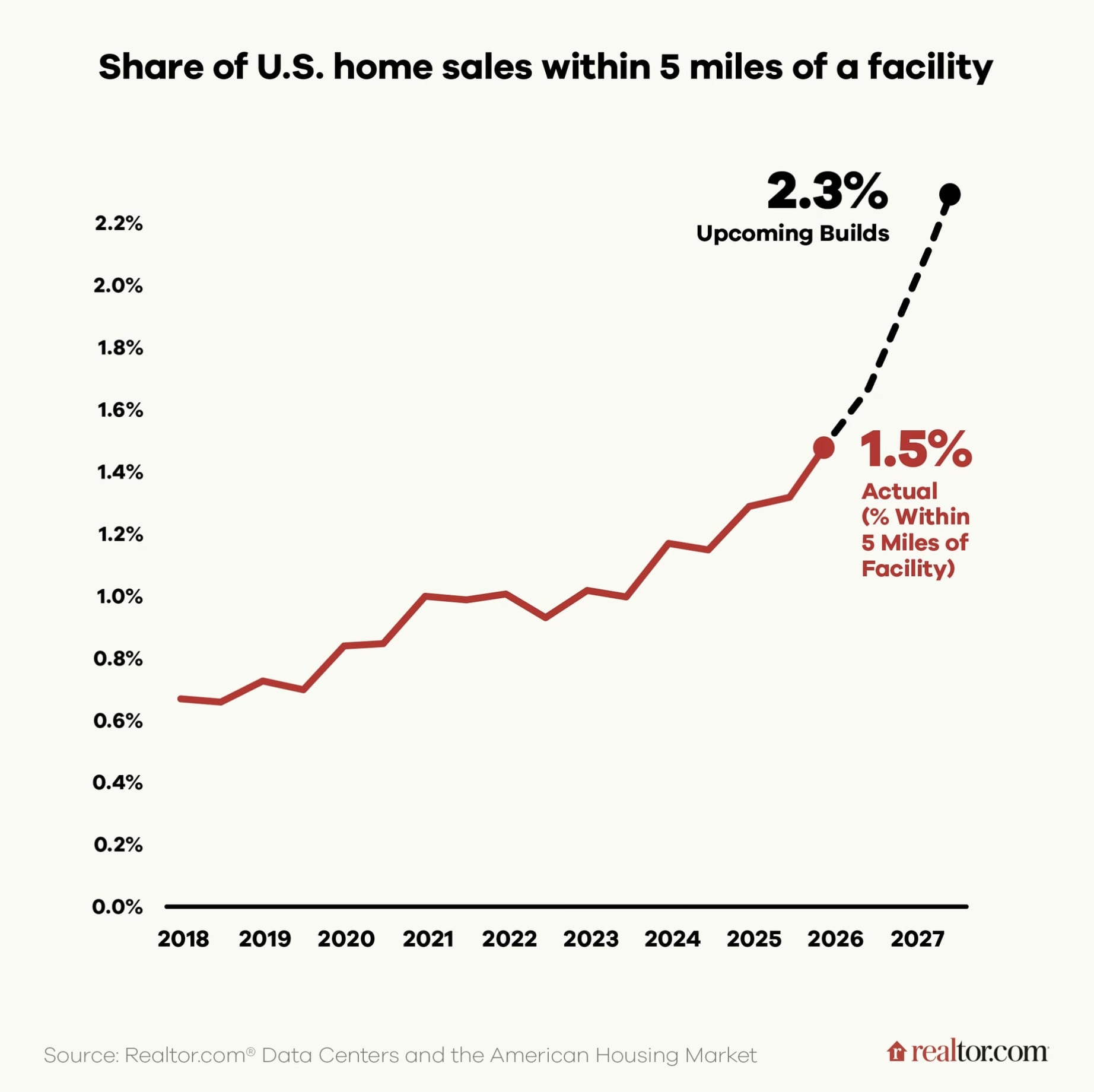

We have all seen it on the news. Data Centers are popping up all of the country to deal with the growth of AI. In fact, the number of large data centers over 50 megawatts has increased sevenfold from 2018, and now U.S. communities host over 350 of them. Not surprisingly, the share of home sales near them has doubled, now accounting for 1.5% of all sales, new Realtor.com® research shows.
By the end of this year, almost 2% of home sales will be near a big data center according to a Realtor.com article. This is not because there is more sales activity around data centers, but instead because there are more data centers in U.S. communities. Logically, data centers are being built in more rural areas and lower-income regions which equals cheaper land and construction costs.
Currently their impact on home values remains unclear but in areas like St. Louis the Fed has reported that their construction is a bright spot in an otherwise gloomy economy. Fueled by surging need for structural steel and copper, the construction boom gave the local economy a much-needed shot in the arm, helping offset weakness on the consumer side.
Other Federal Reserve Banks, including those in Philadelphia, Cleveland, Chicago, Atlanta, and Dallas, likewise reported spiking economic activity driven by data center development.
The flip side of that is that activists point to their enormous consumption of electricity and water for cooling, driving up utility bills for local residents and raising concerns over noise and environmental pollution.
"The environmental impacts of data centers are devastating, which is one of the primary reasons community members remain opposed to their construction," Elyse Schaeffer, policy manager at Missouri Coalition for the Environment (MCE), tells Realtor.com®.
Many municipalities are putting a pause on construction while they review the impacts. Lawsuits abound and there is no one answer on what to do.
The oft-cited fear that data centers could lower nearby home values remains tricky to prove. But the Realtor.com economic research team concluded that so far home prices near data centers move in line with those in areas that don't have them.
After analyzing 43 ZIP codes, some with new centers and some without, Realtor.com found no statistically significant difference.
There are some caveats. Realtor.com could only track data centers in two years after they opened. In that time, the economic boost from the construction jobs hasn't worn off. Some long-term impacts, like electricity prices and noise, could take longer to bear out.
There is no question AI is only going to grow so it is important we stay on top of the issue and that communities manage the resulting data center growth appropriately.