
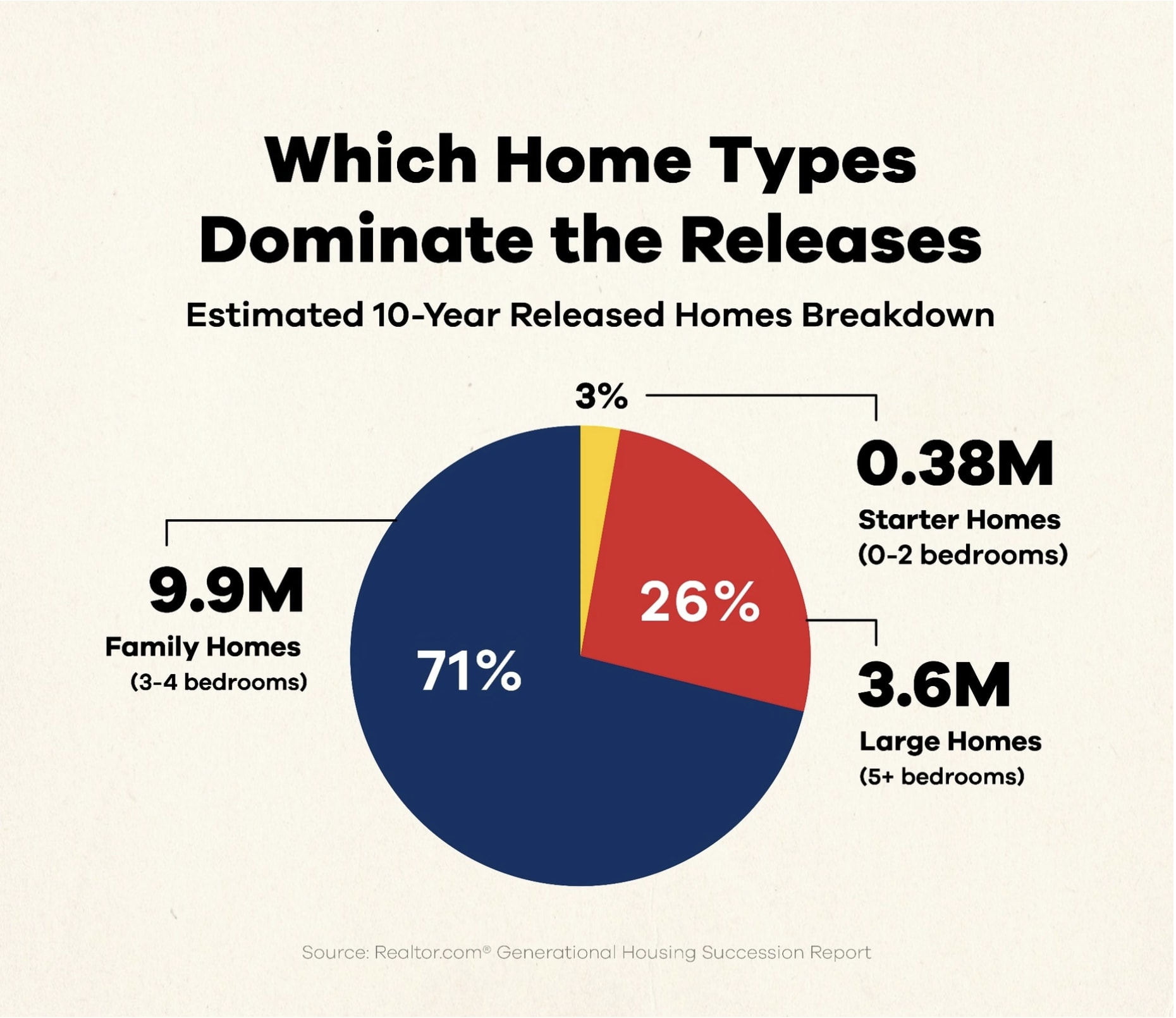

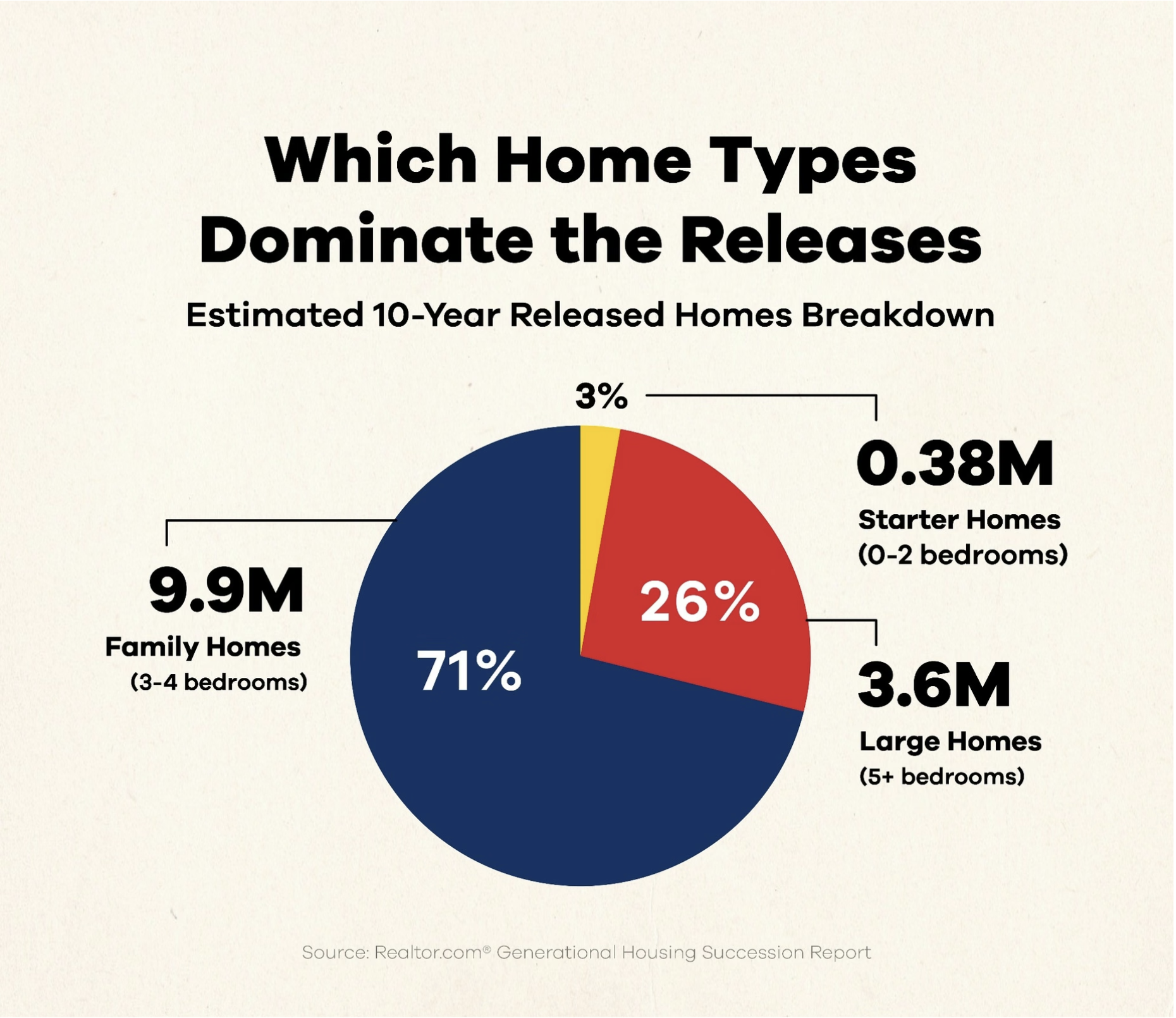
A new Realtor.com analysis projects 13.9 million homes will be sold by aging owners through 2036, with most of the supply coming from mid and large sized homes. That hit on the head what I have been talking with friends and clients about recently. At some point in the near future the graying of America will catch up with real estate and we will have a lot more inventory. The challenge is at today's prices these won't be entry-level properties.
The Realtor.com Generational Housing Succession analysis released today "estimates that 13.9 million homes now owned and occupied by baby boomers and members of the Silent Generation will be released from older owner-occupancy between 2026 and 2036. That would be a 33.7% increase from the pace at which homes were relinquished by older households over the previous decade, and a 74% increase from the number released specifically by boomer and Silent Generation households during that period."
What do the numbers look like? The Realtor.com article goes on to say, "The U.S. had 5.72 million unique homes listed on Realtor.com between July 2025 and June 2026, compared with an annual pre-pandemic average of 6.29 million. That leaves a gap of roughly 570,000 listings.
Against that backdrop, the projected 1.27 million releases in 2027 are substantial. Realtor.com calculates that if 44.8% of those released homes reached the open market, the annual listing count would return to its pre-pandemic level, all else equal. If half of the projected average annual releases over the decade became listings, they would equal about 12.1% of the recent annual listing pool."
This could be good news for buyers but maybe not such great news for sellers. This could impact prices, at least in the segment of the market in which these properties are listed.
“We believe the softness will be real, though its effects will be uneven across segments and markets, not a uniform, nationwide correction,” Jiayi Xu, senior economist at Realtor.com, writes in the report.
Maybe it is a good time to sell that big home ahead of the glut.
It makes sense that as a population ages its housing needs change. I see this every day in my business since I work with many people over 50 as a Seniors Real Estate Specialist. Home owners over 50 have new needs and wants. The big family home, yard and pool are longer worth taking care of since no one uses them. The owners want to travel in retirement and their wealth is tied up in the house. They no longer want to go up and down stairs on a daily basis. My older sellers may also want to go to a living situation where they have meals and/or nursing care available when the time is right. These are all the folks that will be selling in the near future.
The other thing to think about in relation to this is this will cause more competition for modest entry-level properties of two and three bedrooms
Only about 380,000 of the homes projected to be released will have two or fewer bedrooms, the report found. Nearly three-quarters will be three- or four-bedroom family homes, with millions more containing five bedrooms or more.
That means the down-sizing seniors will be competing with the first-time buyers for those smaller, more affordable properties.
Per Realtor.com, "Using American Community Survey households that moved within the previous 12 months as a proxy for recent buyers, Xu found that roughly 30% of buyers of starter-sized homes were 60 or older."
What all this tells me is if you are sitting on equity you might need in the near future consider selling your big home before the market is flooded with other big homes. Let's talk if you are worried about this and see what a path forward might look like for you.